The future of work is not a distant concept anymore. In 2026, it is the operating reality that HR leaders, L&D teams, and event planners are navigating right now — rising AI adoption, hybrid work as a permanent fixture, skills gaps widening faster than training programs can close them, and a generation of entry-level candidates discovering that the traditional hiring ladder has a broken rung at the bottom.
The World Economic Forum projects that 22% of current jobs will be affected by structural labor-market change by 2030. Gartner estimates that 40% of enterprise applications will include task-specific AI agents by 2026, up from under 5% in 2025. Pew Research found that over 50% of U.S. workers are concerned about AI's effect on their jobs. These numbers aren't alarming in isolation — the harder challenge is that they're all happening simultaneously, and the organizations moving fastest are the ones treating them as a connected redesign problem, not separate policy issues.
This piece covers the future of work trends that matter most in 2026, what they actually mean for how companies operate, and how leadership teams and event planners can design programs that prepare people for the work they're moving into rather than the work they're leaving behind.
The great redesign, not the great resignation
The phrase that best fits current future of work trends is the great redesign. Jobs aren't vanishing; tasks are shifting. Skill mixes are changing. Teams are being rebuilt around new workflows that combine people, software, automation, and external talent.
The labor-market outlook supports that view. The World Economic Forum's projection of net job growth through 2030 points to a market in transition, not collapse, in its Future of Jobs Report 2025 digest. The harder management problem is operational: leaders have to decide which work should stay human-led, which should be machine-assisted, and which roles need to be redesigned altogether.
That's why the most serious organizations have stopped asking, "How do we respond to disruption?" They're asking better questions — which tasks are ripe for redesign so employees spend less time on coordination and more on judgment? Which skills are becoming essential for managers and frontline supervisors? Which employee experiences need intentional design now that flexibility and learning are tightly linked?
Many leadership teams get stuck. They recognize the pressure from AI, remote work, and changing talent expectations, but address each issue separately. One team owns AI tools. Another owns real estate. HR owns learning. Internal communications owns culture. The workforce experiences all of it as one system.
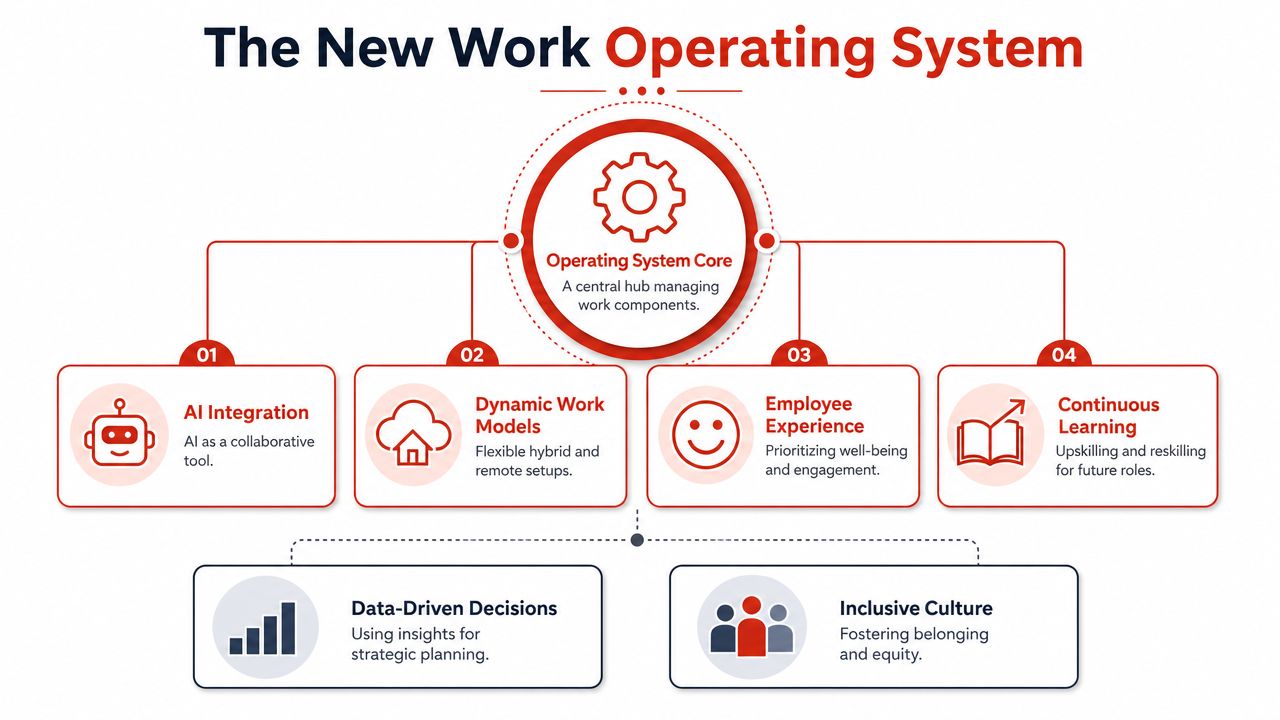
The companies moving fastest are treating future of work trends as a connected redesign of work, workforce, and workplace. That requires a new mental model.
AI and jobs in 2026: from experimentation to operating model
AI adoption at work is shifting from experimentation to operating model design. The central leadership question is no longer whether employees will use AI tools — 75% of knowledge workers already do, according to ManpowerGroup. The question is which decisions, tasks, and controls should stay with people, and which can be handled faster or better by machines.
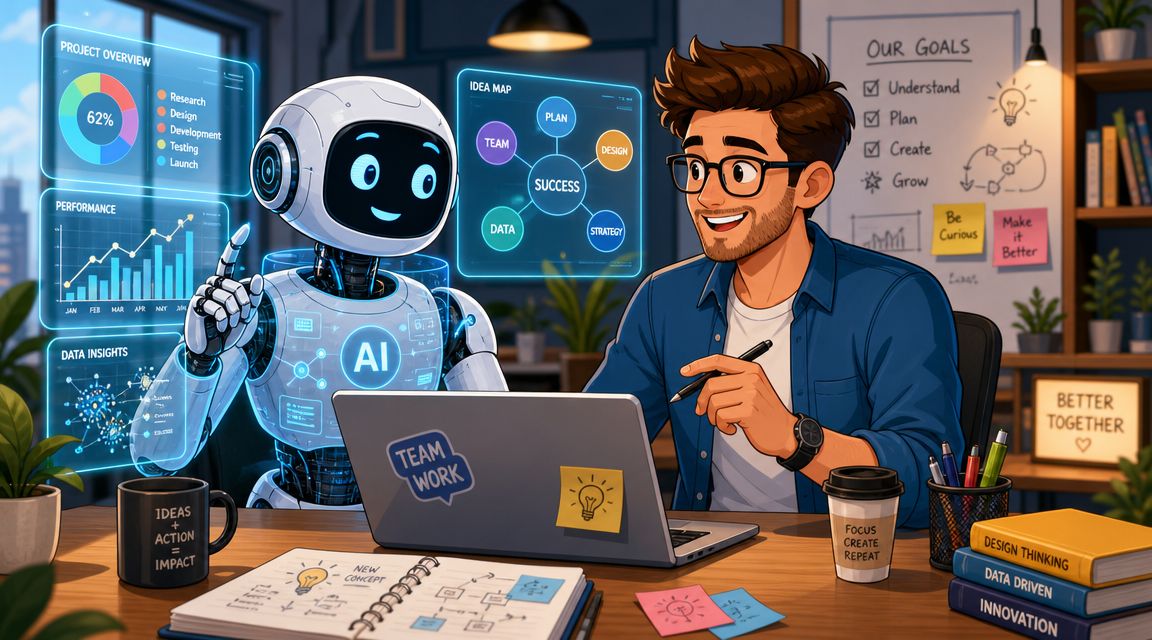
The first wave of enterprise AI created isolated productivity gains, not a repeatable system. Employees used drafting, summarizing, and brainstorming tools on their own — often without role-specific guidance or clear risk standards. The current phase is more disciplined. Companies are defining which decisions benefit from AI speed and which still require human review before action.
High-performing teams are not treating AI as a substitute for judgment. They use it to extend judgment across larger volumes of information, faster workflows, and more routine decisions. A commercial team may use AI to draft outreach, while the account executive still decides tone, sequencing, and customer risk. A manager may use AI to summarize employee feedback, while the manager still has to interpret nuance and respond credibly.
This changes the capability model. Teams now need practical fluency in prompt design, output evaluation, workflow selection, and responsible use. Those are not specialist skills reserved for data scientists — they're becoming part of day-to-day effectiveness in managerial, professional, and frontline roles. A strong primer on artificial intelligence in business can help teams ground that discussion in applied use cases instead of generic hype.
For L&D leaders, the implication is direct. Introductory awareness sessions are no longer enough. Internal programs need hands-on practice tied to actual work — prompt design in context so teams can generate useful outputs for their function, output evaluation so employees can catch weak reasoning or fabricated detail, and workflow judgment so leaders know where AI adds value and where human oversight is required.
The entry-level reckoning
One of the most consequential future of work trends of 2026 gets less attention than it deserves. New graduates now make up only 7% of Big Tech hires, down 50% from 2019, according to SignalFire. AI is handling a growing portion of the work that used to be the entry-level training ground — research, drafting, summarization, data formatting, first-pass analysis.
The result is a broken pipeline. Organizations are reducing the number of early-career roles while simultaneously struggling to find experienced talent: ManpowerGroup reports that 74% of employers have difficulty finding the skilled people they need. Those two facts are connected. The experienced talent of 2028 and 2030 is the entry-level hire who doesn't get hired today.
For leaders planning leadership programs and L&D investments, this raises a concrete question: how do people build the judgment that used to come from doing the low-level work? The answer isn't obvious. But the organizations thinking clearly about this are redesigning early-career pathways — building in deliberate coaching, cross-functional exposure, and feedback loops that AI efficiency was quietly eliminating. A talk by Adam Cheyer, co-creator of Siri, often opens this conversation for leadership teams — he makes the case for where human judgment still compounds in ways AI can't replicate.
Skills as the operating system of work
Skills-based hiring is gaining real traction. In 2026, 81% of C-suite executives plan to adopt skills-based hiring practices, according to LinkedIn's Workforce Report. The shift matters because it changes who gets in and who gets developed — it favors people who can demonstrate what they can actually do over people who hold the right credentials.
The practical challenge is that "skills" in most organizations still means a list on a resume or a tag in an HR system. The organizations doing this well are building learning into actual workflows — not courses scheduled quarterly, but skill development that happens inside the job itself. That means role redesign sits upstream of curriculum design.
ManpowerGroup's Human Edge 2026 Global Trends Report puts it plainly: skills will be "the operating system of work," with programs that develop human potential becoming a business priority. Only 12% of large organizations report sustained investment in skills-based practices — which means the upside for the early movers is significant.
For L&D planners, this reframes the ROI conversation. The question isn't "did people like the training?" — it's "did the capability show up in the work?" Programs that build skills inside live workflows, with coaching that transfers back to the job, are where the measurable outcomes are.
Hybrid work in 2026: flexibility is a baseline, engagement is still earned
Roughly 28% to 30% of eligible workers are now fully remote, according to figures summarized in this future of work statistics roundup. Hybrid work is no longer a transition policy — it's part of the operating model. And 69% of workers say they would accept a pay cut rather than return to full-time office work.
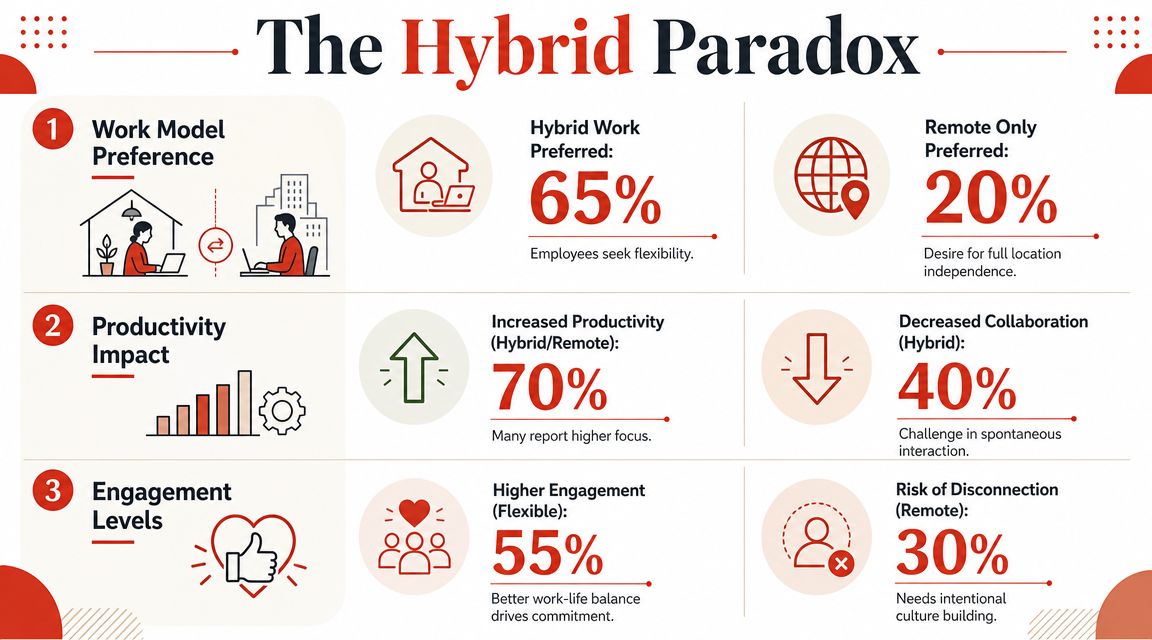
The harder question is whether flexibility is translating into a better employee experience. Gallup data shows U.S. employee engagement at 32% in 2025, with about two-thirds of employees either not engaged or actively disengaged. Leaders should read those figures together. Employees still value flexibility, but flexibility by itself doesn't create trust, coordination, development, or commitment.
Many companies over-indexed on location policy because it was visible and urgent. Employee experience is broader and harder to design well. It depends on manager quality, role clarity, workload design, social connection, growth opportunities, and whether in-person time has a clear purpose.
Four things now matter more than policy language. Manager routines need to be explicit — check-ins, coaching, and recognition cannot depend on hallway visibility. Meetings need a sharper reason to exist; if every conversation defaults to a calendar invite, hybrid work quickly becomes coordination drag. Onboarding needs planned social and cultural touchpoints, not scattered calls and chat threads. Workspaces need to support the work people come in to do — especially collaboration, coaching, and decision-making.
For teams revisiting the physical environment, Cubicle By Design offers a practical guide to hybrid work setup that connects workplace design to how employees split time between home and office.
Events, leadership retreats, and internal learning programs are now part of the operating system for culture. A well-designed offsite can reset manager expectations, establish team norms, and create the shared context that hybrid work erodes between quarterly meetings. The strongest programs translate "engagement" into specific management behaviors and repeatable team practices — not a slogan on a slide.
A practical guide on how to engage employees in hybrid teams can support that work between live sessions.
Polyworking and the fluid workforce
Here's a trend that doesn't show up in most leadership strategy documents: 47% of U.S. workers are now engaged in polyworking — holding multiple income streams or jobs simultaneously. The rise of fractional roles, project-based work, and internal gig marketplaces is changing how organizations think about talent availability and workforce planning.
ManpowerGroup's 2026 report highlights a broader shift toward rapid talent assembly and more flexible job composition. Workforce planning is becoming less about fixed job descriptions and more about how work gets done across shifts, sites, and service moments. Companies that build internal gig markets — where high-performing employees can take on projects outside their primary role — are seeing faster skill diffusion and higher retention among the people they most want to keep.
This also changes the shape of the deskless workforce challenge. A large share of the global workforce does not sit at a desk, yet future-of-work strategy is still often designed around office routines. In a warehouse, redesign centers on scheduling precision, safety, throughput, and task coordination. In healthcare, the pressure points are staffing flow and documentation burden. In retail, the operating questions involve inventory visibility and shift coverage. Those environments don't need a lighter version of office policy — they need workforce systems built for speed, physical presence, and frontline judgment.
What this means for event and leadership program design
Most companies don't need more awareness about future of work trends. They need better program design.
The old event model assumed that a strong keynote plus a good venue would drive alignment. If work is being redesigned across AI, flexibility, management, and workforce composition, internal events need to function like capability-building interventions. The best programs create shared language, help leaders practice new decisions, and move people toward behavior change — all in the same agenda.
A generic "future of work" keynote often underperforms because the audience leaves with broad inspiration but no operating guidance. A better approach is to match the session type to the business problem. If the business need is uneven AI adoption, run workflow clinics by function rather than a broad AI panel. If managers are struggling in hybrid teams, build a manager lab around communication, coaching, and accountability. If the organization needs resilience under pressure, use experiential sessions on focus and performance.
Speaker selection matters. If the objective is human-AI collaboration, Adam Cheyer can help leaders think beyond basic tool usage and into practical redesign of work. If the objective is leadership, resilience, and high performance under pressure, Shannon Rowbury — the first U.S. woman to medal in the Olympic 1500m — creates a strong bridge between elite performance principles and modern management demands. If the audience needs innovation thinking grounded in real deployment, Zach Rattner, whose AI company serves physical industry customers in 20+ countries, can make that conversation concrete.
The strongest internal events use formats that force application. Reverse mentoring sessions where junior employees show leaders how workflows are changing. Scenario labs where cross-functional groups solve a live challenge such as AI governance, manager overload, or frontline scheduling complexity. Role redesign workshops where leaders map one role, identify low-value tasks, and redesign the work around judgment, automation, and collaboration.
For teams building more hands-on formats, corporate workshops for leadership and innovation offer a useful model for moving beyond passive sessions.
A weak agenda is organized by broad themes. A strong agenda is organized by decisions leaders need to make. Instead of naming breakout sessions "AI," "hybrid," and "culture," frame them around actual choices: which work should be redesigned first? What should managers do differently next quarter? Which employee experiences need a deliberate in-person moment? That shift changes audience behavior — people stop listening as spectators and start engaging as owners.
One question to ask before your next internal event
Audit your next major internal gathering. Look at the agenda for your next leadership offsite, all-hands, SKO, or manager summit and ask: does this program prepare people for the work they're moving into, or does it reinforce the work model they're leaving behind?
If the agenda is still heavy on inspiration, updates, and generic panels, redesign one part of it. Add a workflow lab. Add a manager practice session. Add a speaker who has built the future your teams are trying to understand.
A useful companion read on navigating 2026 HR innovations can help HR and people leaders see how these shifts are showing up across the broader talent agenda.
If you're planning an event, offsite, or leadership program around AI, innovation, or the future of work, Silicon Valley Speakers Bureau can help you find speakers and workshop leaders with real operating experience. We work with builders, inventors, and executives who know how to turn emerging workforce trends into sessions your audience will remember — and act on. Tell us what your team is working through and we'll suggest speakers who match the actual problem.